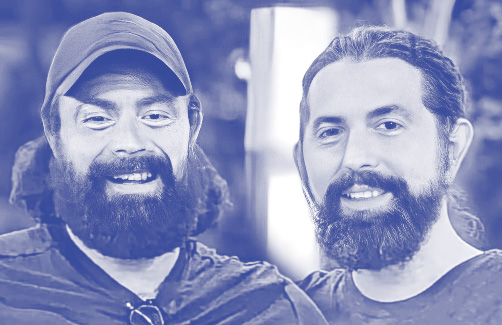
Shalom, mishpacha (family).
Although brought up in the mountains of New York, we’ve spent most of our lives in Texas, which few people consider a Semitic hotspot. God always knows what He’s doing, however. Because Jerusalem sits at roughly the same latitude as Dallas, our southern habitation prepared us for our adventures in the Holy Land.
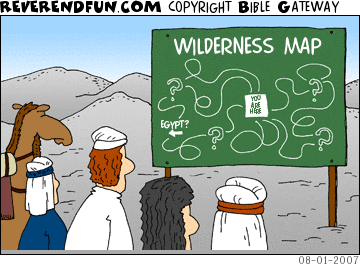
You’d think that, after 30+ years in arid Texas, we would be acclimated to the heat. Yet if you’ve seen our Bearded Bible Brothers broadcasts from Israel, you know that isn’t true. We don’t like the heat — it makes us sweat, which we also don’t like! Whenever Sukkot approaches each year, we wonder if we might have been among the Hebrew complainers forced to wander in the wilderness. Perhaps God gave the original Joshua and Caleb supernatural resistance to desert life. More likely, the Lord spent years developing the character of those mighty men long before they reached the desert.
Despite our preference for cooler climates, God directed us to accept an invitation to “tabernacle” with an organization of Messianic Jews who reenact the yearly feast by camping in Oklahoma’s wilderness. (We really hope that He will one day send us to Siberia!) As we considered the messages that we would be delivering (while sweating), the Holy Spirit clearly defined our theme: the wilderness! The wilderness, or desert, is our training ground, boot-camp, and place of refinement. Truthfully, the desert represents the fallen world where our mortal flesh resides.
As Zola Levitt often taught, the Exodus story — the Israelites leaving Egypt, sojourning in the wilderness, and entering the Promised Land 40 years later — is God’s deliberate metaphor for every Believer’s spiritual “walk.”
Egypt represents bondage to sin, the old life that God calls us to leave. During their wilderness journey, many Israelites repeatedly wanted (and tried) to return to Egypt. Their Heavenly Father was clearly upset. Thus, He judged their rebellion because they denied His supernatural deliverance and the power of His salvation by choosing instead to return to a life of sin. Later, God commanded Israel’s kings never to return to Egypt (Deut. 17:16), not even for horses. That land was a snare, because the Hebrews worshiped Egypt’s foreign gods (Ezek. 20:8).
Paul used this analogy to explain that the Hebrews’ wilderness failures serve as our example:
Moreover, brethren, I do not want you to be unaware that all our fathers were under the cloud, all passed through the sea, all were baptized into Moses in the cloud and in the sea, all ate the same spiritual food, and all drank the same spiritual drink. For they drank of that spiritual Rock that followed them, and that Rock was Christ. But with most of them God was not well pleased, for their bodies were scattered in the wilderness. Now these things became our examples, to the intent that we should not lust after evil things as they also lusted (1 Cor. 10:1–6).
Truthfully, the wilderness is an excruciating walk through the fire that refines our souls. It removes impurities, chaff, and fleshly habits, leaving only what is valuable. Peter emphasized:
In all this you greatly rejoice, though now for a little while you may have had to suffer grief in all kinds of trials. These have come so that the proven genuineness of your faith — of greater worth than gold, which perishes even though refined by fire — may result in praise, glory and honor when Jesus Christ is revealed (1 Pet. 1:6–7).
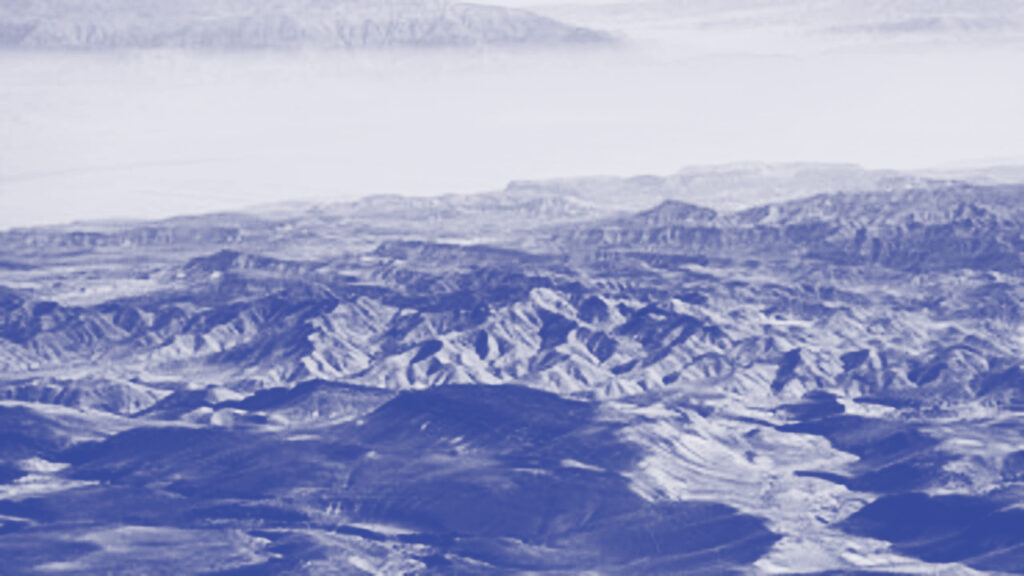
credit: BiblePlaces.com
Throughout Scripture, many of God’s servants spent time in the wilderness preparing for their calling. Elijah spent 3 ½ years in the desert, where God directed ravens to feed him, before the prophet confronted Ahab. Paul spent possibly three years in Arabia’s desert where God refined his doctrine, removing the legalistic spirit from him. John the Baptizer spent his life in the wilderness eating locusts and honey in preparation for ministry.
Yeshua went to the desert for 40 days where He was tempted by Satan before angels came to provide Him sustenance. And, of course, the Hebrews’ 40-year wilderness journey wasn’t really torture — God graciously fed them “angel bread” and quail, gave them shade by day and fire by night, and maintained their clothes for decades. Yahweh Yireh (“The Lord will provide,” Gen. 22:14) is our Provider!
Remember, you are never alone! We Believers are all trudging through this wilderness together, called to encourage and strengthen one another as a community, the Body of Messiah.
While the wilderness represents our time on Earth, ultimately, Yeshua (the greatest Joshua) will lead us into Heaven, His Promised Land, where we receive the gift that He guaranteed us. Our earthly time won’t be perpetual suffering — there are valleys and mountains, times of labor and harvest. Paul encourages: “Let us not become weary in doing good, for at the proper time we will reap a harvest if we do not give up” (Gal. 6:9). Using the example of the Israelites in the wilderness, Hebrews 3:14–4:11 reminds us not to rebel when we’re faced with struggles; if we are faithful, God will give us rest and ultimately lead us to an eternal Sabbath rest.
During Sukkot (which this year begins at sunset on Sept. 25), remain confident that though we sojourn as strangers in this land called Earth (Heb. 11:13–16), one day we will receive the goodness of the Lord in the land of the living (Ps. 27:13) — partially in this age, but completely in the age to come.
Love, Joshua and Caleb

P.S. Thank you for your offerings and gifts to help your ministry continue. We pray that our Heavenly Father provides for all your needs — physical, emotional, and spiritual — as He has promised.
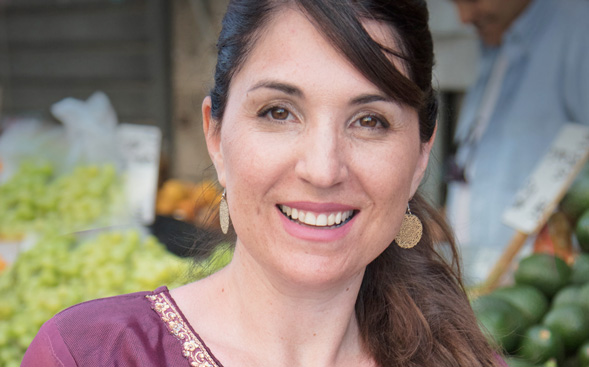
FROM SARAH, OUR SABRA
ON THE GROUND IN ISRAEL
Dear Friend,
Shalom from the Holy Land. While much of the world is settling into autumn routines, Israelis are preparing for something entirely different. If you visit Israel in mid-September, you’ll find supermarkets filled with apples, honey, pomegranates, and round challah bread. Schools and businesses plan around the upcoming Biblical holidays. Conversations shift from asking, “What are you doing in October?” to “What are you doing after Sukkot?”
Though outsiders might consider these minor cultural differences, they reveal something much deeper about Israel. We operate on two different calendars, both of which are important.
One Nation, Two Calendars
Like most countries, Israel functions according to the Gregorian calendar (January–December) for business, international travel, and government administration. Beneath that secular schedule, however, lies another calendar that shapes how we Israelis live.
The Jewish calendar — rooted in Scripture — determines when schools close, families gather, national holidays are observed, and the country pauses to celebrate or reflect. While Americans refer to time during a month (such as in early- or late-September), Israelis often say, “before Rosh Hashanah” or “during Sukkot.”
This dual-calendar system is one of the unique characteristics of Israeli society. It allows us to participate fully in the modern world while preserving a rhythm of life that stretches back thousands of years to Biblical times.
The High Holidays
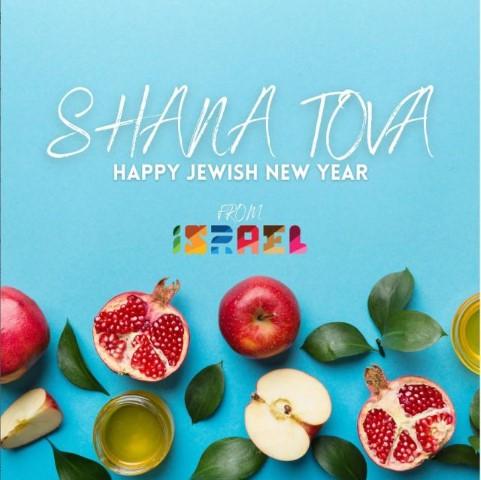
The Jewish calendar’s influence is especially notable during the High Holidays. In September, we begin a cycle of my favorite time of the year: the fall festivals. As Rosh Hashanah (Feast of Trumpets, which this year begins at sunset on Sept. 11) approaches, the atmosphere changes across the country. Families prepare festive meals, school children take a holiday break (even though they only started the school year on September 1), and people wish each other Shanah Tovah (a good year).
For many visitors to Israel, Yom Kippur (the Day of Atonement, which this year begins at sunset on Sept. 20) is an unforgettable experience. Commercial flights stop, television and radio programming cease, businesses close, and roads become remarkably quiet. Children ride bicycles on highways that are normally packed with traffic, while millions of Israelis spend the day fasting, praying, reflecting, or simply respecting the unique atmosphere.
Remarkably, the pause extends beyond religious communities. Many secular Israelis who rarely attend synagogue still honor the day. In a world that rarely slows down, this part of Israeli life reminds us of the importance of stopping for a time.
Ancient Festivals in a Modern Nation
One of the greatest surprises for Christian visitors to Israel is seeing Biblical festivals woven naturally into modern life. For Believers who read about these celebrations in the Bible, seeing them lived out here provides a fresh appreciation for the land where much of Scripture unfolded.
During the festival of Sukkot, temporary shelters (sukkot) appear everywhere — in apartment balconies overlooking Tel Aviv, outside restaurants in Jerusalem, in kibbutzim, hospitals, shopping centers, and even on military bases. Families eat meals in these simple structures just as Jewish people have done for generations.

credit: Sarah Liberman
For me, this is one of the most special times of the year. Shortly before Sukkot begins, our faith community gathers to build our community sukkah (singular of sukkot). Each year’s sukkah has a theme, and I really enjoy designing, planning, and purchasing supplies to make the experience as beautiful and memorable as possible. Later, we share the festive meal of Erev Sukkot (the Feast of Tabernacles) in our sukkah; some people even sleep there during the seven-day festival.
More Than Religion
These traditions aren’t observed only by religious Jews. Many Israelis who describe themselves as secular also celebrate the Biblical holidays with family and friends. For them, these festivals are part of a shared national identity. This is similar to how most Americans — even those who aren’t Christians — celebrate Christmas.
In Israel, the holidays serve as cultural anchors as well as religious observances. Though religious and secular Jews may disagree on many issues, they still gather around the same holiday tables and celebrate the same traditions. After the challenges Israel has experienced during the past few years, the anchor of these festivals feels even more important.
When The Bible Shapes Time
Israel — often called the “Start-Up Nation” — is a global leader in technology, medicine, agriculture, and innovation. Yet even in this modern, fast-paced society, the calendar still follows rhythms established by the Lord.
Here the ancient and the modern exist side by side, and this coexistence feels perfectly natural. The Biblical calendar not only influences school schedules and family gatherings but also governs the pace of the streets. As the High Holidays begin, we again mark time according to a God-given calendar: “These are My appointed festivals, the appointed festivals of the Lord, which you are to proclaim as sacred assemblies” (Lev. 23:2).
Amazingly, thousands of years later, God’s appointed times (moedim) still shape our everyday lives here in Israel.
When the sound of the shofar echoes across Israel and families gather around holiday tables this month, we are reminded that God’s story is not confined to the pages of Scripture — it is still shaping our lives. Here, the calendar is a living connection to God’s Word.
Beyond simply edicts from the Lord, the festivals are all symbolic of Messiah’s First and Second Coming. My family and I are blessed to participate in this Biblical rhythm. The writer of Ecclesiastes reminds us: “There is a time for everything, and a season for every activity under the heavens” (Ecc. 3:1). I encourage you to find ways to incorporate these festivals into your year.

Im tirdefu lada-at oto —“Press on to know HIM!” (Hosea 6:3 NLT)
Many blessings from Israel,

Sarah Liberman
ZLM’s Websites
To better benefit from our ministry’s expansive resources, please visit all three of our websites:
Thousands of ZLMers regularly visit Levitt.com to:
- Watch our newest weekly installment of the Bearded Bible Brothers and access hundreds of archived 30-minute episodes (including those from Our Jewish Roots and Zola Levitt Presents) for free viewing
- Read our monthly news magazine, LLX news reports, Biblical and prophetic essays, Q&A, Blog, Daily Devotionals, and more
- Order our Bible teaching books, DVDs, CDs, and specialty items
This newer website allows you to:
- Find online Bible-teaching videos of the BBBs’ recent television series
- Subscribe to the BBBs’ free YouTube channel
- Learn about Joshua and Caleb’s ministerial endeavors over many years
Patreon.com/BeardedBibleBonanza
- See our newest public and exclusive posts
- Browse our recent and most popular Bible, history, and prophecy lessons
- Join for free, or, for as little as $5 per month, get an all-access pass to:
- Never-aired-elsewhere content
- Behind-the-scenes moments
- Older BBB teaching archives
- Faith-filled fun for the whole family
Bearded Bible Brothers® TV programs in September
This month, we continue Return of the Nephilim. This new series highlights the globetrotting adventures of the BBB and others as they uncover the mystery behind the Nephilim, the origin of all false religions, and Satan’s plot to use the Beast as his genetic seed to deceive the nations.
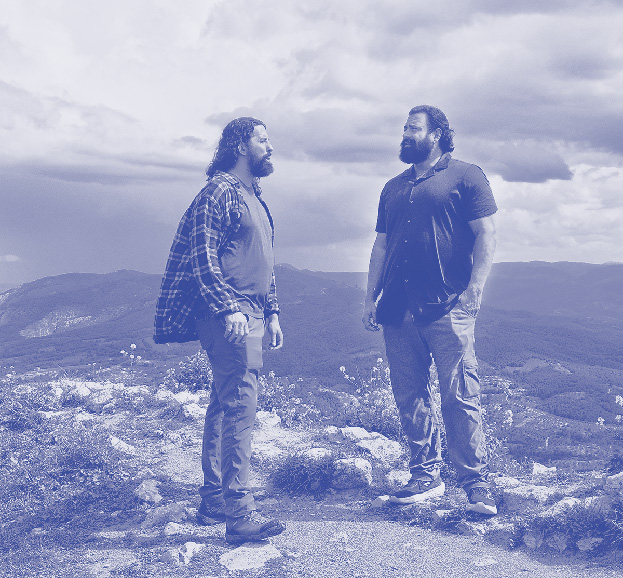
The New Breed and the Gigantomachy — How did Nephilim repopulate the Earth after the Flood? On the Peloponnese peninsula in southern Greece, the brothers visit the sites of Tiryns, Megalopolis, and Mycenae to spotlight the continuing wars of giants and gods.
The Days of Lot — The “Days of Noah” and “Days of Lot” are Yeshua’s explicit warnings for these Last Days. To help us understand those ancient times, the journey continues to the Biblical cities of Sodom and Zoar near the Dead Sea in Jordan. Caleb’s daughter Shoshannah assists in the effort.
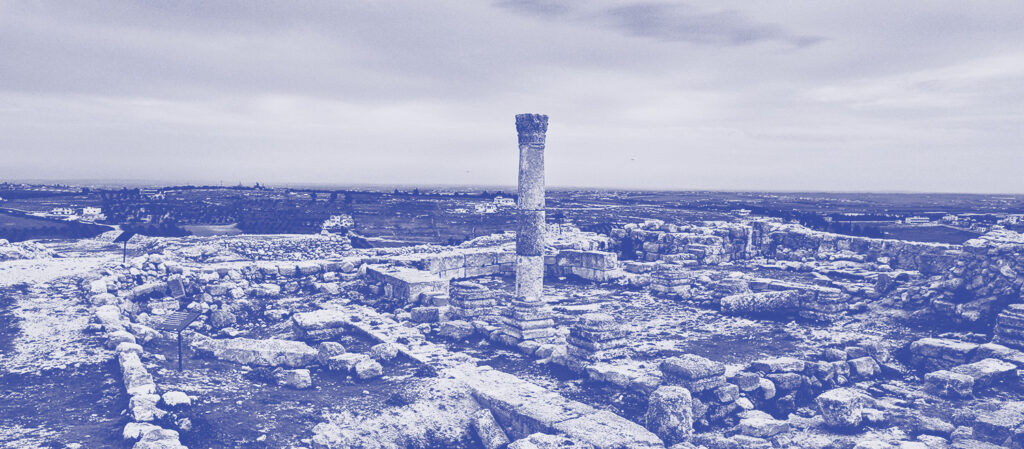
The Sins of the Canaanites — Joshua and Caleb stop at the Tell Hisban Canaanite ruins before being threatened by Jordanian officials at Tel el-Hammam. The idolatry and genetic perversity of Canaan’s giants come to light as the brothers finally arrive at Hebron in Israel.
Atlantis Restored and New-Breed Syncretism — The Minoans strike back as the brothers rejoin Pastor Hirchie Schaffner to explore the Philistine Pentapolis cities of Gath, Ekron, Ashdod, and Ashkelon. Was Goliath’s gigantism just a fluke, or was there more genetic manipulation than meets the eye?